
"there has only ever been one perfect man, the Lord Jesus, and we killed him. I only missed a putt."
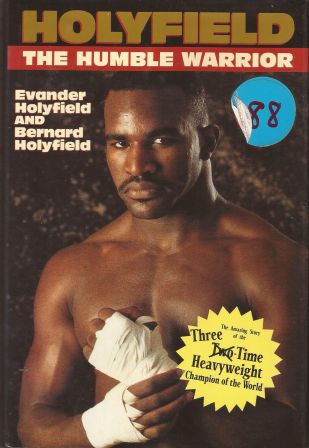
Holyfield, The humble warrior
Return to the book list for this category.
Evander and Bernard Holyfield, London, Thomas Nelson, 1996. ISBN 0-78 52-7693-9
The book, written by his brother tells the story of Evander Holyfield and reveals him as a man who “had decided long ago to follow Jesus Christ inside and outside the ring”. The book traces his career from starting to box as a boy, through his amateur and professional career to being World Champion.
Holyfield saw boxing as his calling, making statements like: “I would like to thank almighty God for sharing His blessings on life in the sport of boxing”, “fighting for God” and “God had created him to be a boxer”. There is a reference to boxing as spiritual warfare.
The statement: “If he gave up [boxing] now, he’d be spitting in the face of the Almighty” reminds one of the words attributed to Eric Liddell in Chariots of Fire “I believe God made me for a purpose —for China—but when I run I feel his pleasure and to give it up would be to hold him in contempt. To win is to honour him.”
The book also quotes Holyfield: “Boxing is 90 percent spiritual and 10 percent physical. It’s the spiritual aspect that gives the edge and an extra burst of energy to draw from when I am in a war. My victories are not achieved by my might, nor by my power but by the Spirit of Christ who strengthens me”.
More questionable is the thought “God would never put me in a position to lose. His will is that I win in the ring and outside”.
When he fought George Foreman, also a Christian, he was anxious that Foreman had access to the same supernatural strength that he did and that he (Holyfield) had lost the edge that he had fighting for God against opponents who were not followers of God.
Holyfield’s favourite Bible verse is Philippians 4:13 (“I can do all things through Christ who strengthens me”). He had it inscribed on his world championship belts and added to autographs. The books states that the verse was the theme of his career. However, his interpretation of the verse ignores the Pauline context, seeing it as a promise of God’s strength when he fought.
There is a lot about prayer in the book starting with a reference to Evander learning as a boy that God answered prayer. The books says: “prayer would be every bit as essential to his success as was his right hook or left uppercut”. He attributes success to prayer like: “I’m just thankful God answered my prayers and let me make the Olympic team.” In the book’s description of a fight with Riddick Bowe, there is a reference to “Evander’s most physical form of prayer”. However, we are also told that he doesn’t pray that he will win but that God will allow him to do his very best.
There are only two references to what might be described as a theology of boxing:
“Some Christians have a problem with boxing, but that’s mostly because they don’t understand the sport and the goodwill that often exists between the two combatants even after a fight” and “What I do ls not violent. Violence is somebody is in a rage of madness. There is no rage when I am in the ring. It’s a skilled sport.” I would have liked more on that aspect.